
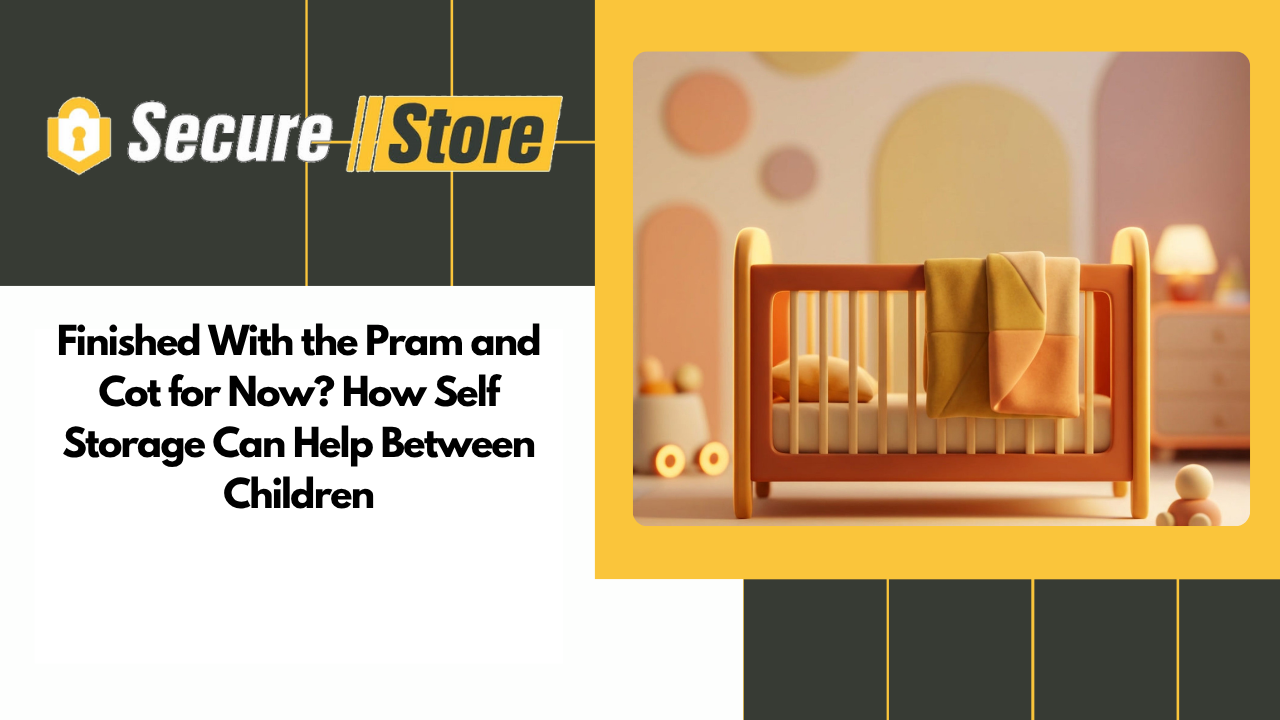
Babies may be small, but the equipment that comes with them certainly isn’t.
Prams, cots, highchairs, travel cots, baby baths, changing equipment, toys, clothes and nursery furniture can quickly fill a home.
Then your child grows.
Suddenly the cot isn’t needed. The highchair disappears from the kitchen. The baby bath has been outgrown. The pram is replaced by something lighter.
But if you’re considering having another child in the future, getting rid of everything immediately may seem wasteful.
Replacing good-quality baby equipment can be expensive.
So where does it all go in the meantime?
For many families, the answer becomes the loft, garage, spare bedroom or every available cupboard.
Temporary or longer-term self storage can offer another option.
SecureStore provides flexible personal self storage and Removal + Storage across Bury, Manchester, Failsworth and Salford, helping families keep suitable belongings they may need again without allowing them to dominate everyday living space.
2-Week Flash Offer: First Month’s Storage for Just £1
If you’ve recently reached the end of the baby stage but aren’t ready to part with everything, our current flash offer could make this a useful time to get organised.
For two weeks only, get your first month of storage for just £1.
Suitable nursery furniture, children’s clothing, toys and other household belongings can be organised and stored while you reclaim valuable space at home.
2-WEEK FLASH OFFER
FIRST MONTH’S STORAGE: £1
Promotional terms, eligibility and availability apply.
Call 0161 470 0288 or email info@securestoreselfstorage.co.uk to enquire.
Why Baby Equipment Creates Such a Storage Problem
The difficulty isn’t necessarily the number of items.
It’s their size.
A folded babygrow takes almost no room.
A full-size cot is different.
So is a pram.
Add a highchair, changing table, travel cot, play equipment and boxes of clothing, and you’ve suddenly got a significant amount of equipment that isn’t being used.
If you’re keeping it for another child, that equipment could remain unused for months or even years.
First Decide What Is Actually Worth Keeping
Don’t automatically store everything.
Before packing anything away, ask:
Would we genuinely use this again?
Consider:
- Condition
- Quality
- Original cost
- Replacement cost
- Available storage space
- How likely you are to need it again
Something that was hardly used and remains in excellent condition may be worth keeping.
Something already damaged or heavily worn may not be.
Make Four Categories
A simple sorting system can prevent you storing things unnecessarily.
Keep and Store
Suitable belongings you genuinely expect to use again.
Keep at Home
Items still being used by your child.
Sell or Donate
Good-quality belongings you no longer need.
Dispose or Recycle Appropriately
Items that are damaged, unsuitable or have reached the end of their useful life.
This is much better than simply putting everything into boxes marked “baby stuff”.
Nursery Furniture Can Consume an Entire Room
A nursery might contain:
- Cot
- Changing unit
- Wardrobe
- Drawers
- Nursing chair
- Toy storage
- Shelving
As your child grows, the room may need to change.
The cot becomes a bed.
The changing area becomes unnecessary.
Larger toys arrive.
A desk may eventually be needed.
If you’re keeping suitable nursery furniture for the future, moving it elsewhere can allow the bedroom to evolve with your child.
Disassemble Furniture Carefully
Where appropriate, some furniture can take up considerably less room when dismantled.
Before taking anything apart:
- Photograph it assembled.
- Keep the manufacturer’s instructions if you still have them.
- Photograph important connections.
- Keep fixings together.
- Label everything clearly.
A small bag of unidentified screws two years later isn’t particularly helpful.
Attach Fixings to the Furniture
If suitable, place screws and fittings into a labelled bag and keep that bag securely with the relevant furniture.
For example:
COT – ALL FIXINGS
CHANGING UNIT – SCREWS AND BRACKETS
Don’t create one enormous container labelled “random furniture screws”.
Future you will not appreciate it.
Keep Assembly Instructions
If you still have the original manual, store it with the item.
If not, check whether the manufacturer provides instructions online before dismantling the furniture.
This can make reassembly much easier later.
What About the Pram?
A good-quality pushchair or pram can represent a significant purchase.
If you’re planning to keep yours, clean it properly before storage.
Remove crumbs, mud and everyday dirt.
Empty every pocket.
Check storage baskets.
Remove any belongings from compartments.
Allow fabric components to dry thoroughly before packing.
Always follow the manufacturer’s care and storage instructions for your specific product.
Don’t Store Things Dirty or Damp
This applies to far more than prams.
Before putting suitable children’s belongings away, make sure they’re clean and dry.
That includes:
- Fabric items
- Toys
- Bedding
- Clothing
- Nursery accessories
Packing damp belongings away for a long period is asking for problems.
Take the extra time to prepare them properly.
Baby Clothes Need a System
Baby and toddler clothes accumulate incredibly quickly.
A child might move through several sizes in a relatively short period.
If you’re keeping clothing for a younger sibling, don’t put everything into random bags.
Sort by size.
For example:
NEWBORN
0–3 MONTHS
3–6 MONTHS
6–9 MONTHS
9–12 MONTHS
12–18 MONTHS
Then separate seasonal items if necessary.
When you need them again, you can retrieve the right box rather than searching through everything.
Be Selective With Clothing
Not every baby vest needs preserving.
Go through each size before packing it away.
Keep clothing that is:
- In good condition
- Likely to be reused
- Sentimentally important
Remove items that are heavily worn or no longer suitable.
This can substantially reduce the number of boxes you need.
Create a Separate Memory Box
Some children’s clothes aren’t being kept because they’re practical.
They’re being kept because they’re special.
Perhaps it’s:
- Coming-home outfit
- First Christmas clothing
- Favourite baby blanket
- First shoes
- Hospital wristband
- Special cards
- Favourite early toy
Don’t mix sentimental items with everyday hand-me-down clothing.
Create a dedicated memory box.
That way, practical baby clothes can eventually be passed on without accidentally losing something meaningful.
Toys Need Regular Sorting Too
As children develop, the types of toys they use change rapidly.
Baby toys become toddler toys.
Toddler toys become preschool toys.
But the previous stage often remains in cupboards.
Before storing toys, ask whether they’re genuinely worth keeping.
A good-quality toy you expect another child to use may be.
A broken toy missing several pieces probably isn’t.
Keep Complete Sets Together
If a toy has multiple pieces, store them together.
Use clearly labelled containers where appropriate.
Future retrieval becomes much easier when everything required to use an item is still with it.
Books Are Often Worth Keeping
Children’s books can be reused for years and potentially passed between siblings.
If you’re keeping books, pack them carefully and avoid overloading boxes.
Books become surprisingly heavy when packed together.
Smaller manageable boxes are generally easier to move than enormous containers filled to the top.
Be Particularly Careful With Child Car Seats
Child car seats are different from ordinary household belongings because they are safety-critical products.
Don’t assume that because a seat looks fine it will necessarily be appropriate to reuse several years later.
Before considering future reuse, check:
- Manufacturer guidance
- Product instructions
- Current condition
- Whether it has been involved in an accident
- Current legal requirements
- Whether any recalls or safety notices apply
The UK Government provides guidance on child car seats:
GOV.UK – Child Car Seats
gov.uk/child-car-seats-the-rules
The Royal Society for the Prevention of Accidents also publishes child car-seat information:
RoSPA
rospa.com
Always follow current manufacturer and safety guidance rather than relying solely on how a product looks.
Don’t Assume Every Baby Product Should Be Reused
Safety guidance and product standards can change.
Products can also deteriorate or be recalled.
Before reusing stored baby equipment, check the current manufacturer’s guidance and relevant safety information.
This is particularly important for products associated with sleeping, travel and restraint.
Storage preserves space in your home; it does not guarantee that an item will remain appropriate for future use.
Highchairs Can Be Surprisingly Bulky
Once a child moves on from a highchair, it can become an awkward object to keep around.
If yours folds, follow the manufacturer’s instructions and store it appropriately.
If components are removable, keep everything together and clearly labelled.
Clean food residue thoroughly before storage.
Travel Equipment Adds Up
Families often accumulate:
- Travel cot
- Portable highchair
- Baby carrier
- Changing bag
- Travel accessories
- Holiday equipment
Some of these may continue to be useful.
Others may only be required again for another baby.
Grouping travel equipment together can make future retrieval much easier.
What About Baby Baths and Changing Equipment?
These items can take up substantial cupboard space despite no longer being needed.
Before storing them, check whether you realistically expect to use them again.
Clean and dry suitable equipment thoroughly and keep related accessories together.
Don’t Sacrifice the Spare Bedroom
The spare bedroom often becomes the default location for everything children have outgrown.
First comes the cot.
Then bags of clothes.
Then the pram.
Then toys.
Eventually the room can no longer accommodate a guest.
If you’re keeping a significant amount of suitable equipment, dedicated storage can help you retain the belongings without sacrificing an entire room at home.
Reclaim Your Wardrobes
Baby clothes often migrate into every wardrobe in the house.
If your child has already outgrown several sizes, move those clothes out of everyday storage.
Your best wardrobe space should be used for belongings your household currently needs.
Reclaim the Garage
Prams, cots and children’s equipment can also consume valuable garage space.
Before long, you may struggle to access:
- Bikes
- Tools
- Garden equipment
- Car accessories
- Sports equipment
Moving suitable long-term belongings into dedicated storage can help the garage function properly again.
Be Careful With Loft Storage
Lofts vary significantly.
Temperature, moisture, accessibility and structural suitability all need consideration.
Heavy or bulky equipment can also be difficult to move safely through loft openings.
Don’t automatically assume the loft is the right place for every item simply because it is out of sight.
Sell Things While They Still Have Value
Children’s equipment can lose resale value as models change and items age.
If you’re certain you won’t use something again, selling it sooner may make more sense than storing it indefinitely.
Depending on the item, platforms include:
eBay UK
ebay.co.uk
Vinted UK
vinted.co.uk
Facebook Marketplace
facebook.com/marketplace
For safety-related children’s products, be particularly careful and follow applicable rules, manufacturer guidance and platform requirements.
Donate Suitable Children’s Items
Some charities accept particular children’s clothing, toys, furniture or equipment, but policies vary.
Check directly before donating.
Barnardo’s
barnardos.org.uk
Oxfam
oxfam.org.uk
Never assume a charity can accept every type of baby product, particularly safety-related equipment.
Create a Proper Inventory
If you’re keeping children’s equipment for several years, it’s easy to forget what you have.
Create a simple inventory.
For example:
Box 1: Newborn clothes
Box 2: 0–3 month clothes
Box 3: 3–6 month clothes
Box 4: Baby toys
Box 5: Bedding
Large item: Cot and fittings
Large item: Highchair
You can keep the list on your phone.
Photograph Everything Before Storage
Photos can be extremely useful.
Photograph:
- Furniture before dismantling
- Box contents
- Product labels
- Model information
- Accessories belonging to larger items
You don’t need an elaborate database.
A clearly labelled photo album on your phone may be enough.
Put Things You May Need First Nearer the Front
Think about the order in which belongings might be needed again.
If you are storing clothing from newborn through to two years, you don’t want newborn boxes buried underneath everything else.
Pack the unit logically.
Future accessibility matters.
Review Everything Once a Year
Plans change.
You may initially intend to keep every piece of baby equipment.
A year later, your circumstances may be different.
Review stored belongings periodically and decide whether everything still needs to be kept.
This prevents a temporary storage decision becoming indefinite by accident.
Don’t Feel Obliged to Keep Everything for Sentimental Reasons
Children’s belongings can carry strong memories.
But you don’t need to keep every toy, every outfit and every piece of furniture to preserve those memories.
Choose the things that genuinely matter.
Photograph other items before letting them go if that helps.
A carefully chosen memory box can be more meaningful than 20 boxes nobody opens.
Removal + Storage Can Help With Bulky Nursery Furniture
Cots, drawers and nursery furniture can be awkward to move.
SecureStore provides Removal + Storage, allowing you to discuss moving suitable household belongings as well as storing them.
This can be particularly useful if you’re clearing a nursery so that the room can evolve as your child grows.
Use SecureStore’s £1 First-Month Flash Offer
If you’ve reached the stage where baby equipment is no longer being used but you’re not ready to get rid of it, our current offer could make this a useful time to reorganise.
For two weeks only:
GET YOUR FIRST MONTH OF STORAGE FOR JUST £1
Suitable storage could help you make room by moving:
- Nursery furniture
- Prams and pushchairs
- Highchairs
- Travel equipment
- Boxes of children’s clothing
- Toys
- Books
- Keepsakes
- Other suitable household belongings
2-WEEK FLASH OFFER – FIRST MONTH’S STORAGE £1
Promotional terms, eligibility and availability apply.
How to Book Your Unit With SecureStore
Getting organised is straightforward:
- Gather the baby and children’s equipment you’re no longer using.
- Decide what is genuinely worth keeping.
- Sell, donate or appropriately dispose of items you don’t need.
- Clean and thoroughly dry suitable belongings before storage.
- Sort clothing by size.
- Label boxes clearly.
- Keep furniture fixings and instructions with the relevant item.
- Contact SecureStore and ask about our 2-week flash offer – first month’s storage for £1.
- Choose a suitable storage unit.
- Ask about Removal + Storage if bulky furniture needs moving.
2-WEEK FLASH OFFER: FIRST MONTH’S STORAGE FOR £1
Call: 0161 470 0288
Email: info@securestoreselfstorage.co.uk
Visit: 574 Manchester Road, Bury
Locations: Bury | Manchester | Failsworth | Salford
No deposit required in many cases; same-day move-in may be available.
Contact SecureStore for promotional terms, eligibility and current unit availability.
Keep What You May Need Again Without Letting It Take Over Your Home
The period between needing baby equipment can create an awkward decision.
Get rid of everything and you may end up buying it again.
Keep everything at home and you can lose a huge amount of valuable living space.
The answer doesn’t have to be one extreme or the other.
Be selective.
Keep good-quality suitable belongings you genuinely expect to reuse.
Sell or donate what you won’t.
Preserve a small number of meaningful keepsakes.
Then store suitable items in an organised way so your home can move on to the next stage of family life.
SecureStore provides flexible personal self storage and Removal + Storage across Bury, Manchester, Failsworth and Salford.
And for a limited period, your first month of storage is just £1 with our 2-week flash offer.
Call 0161 470 0288 or email info@securestoreselfstorage.co.uk to discuss your storage requirements.
Frequently Asked Questions
Is self storage useful for baby equipment between children?
It can be. Suitable nursery furniture, clothing, toys and other belongings you expect to reuse can take up substantial space at home while they’re not needed.
How should I organise baby clothes for storage?
Sort them by size and, where useful, season. Clearly label each box so you can retrieve the right clothes without opening everything.
Can I store a child car seat and reuse it later?
Child car seats are safety-critical. Before future reuse, check current manufacturer guidance, condition, accident history, relevant recalls and current legal and safety guidance. Do not assume storage alone means a seat remains suitable for reuse.
Should I clean baby equipment before storing it?
Yes. Suitable belongings should generally be clean and thoroughly dry before being packed away, following the manufacturer’s care instructions where applicable.
Can SecureStore help move nursery furniture?
Yes. SecureStore provides Removal + Storage. Speak to our team about the suitable furniture and other belongings you need moving.
What is SecureStore’s current flash offer?
For a limited two-week period, your first month of storage is £1, subject to promotional terms, eligibility and availability.