
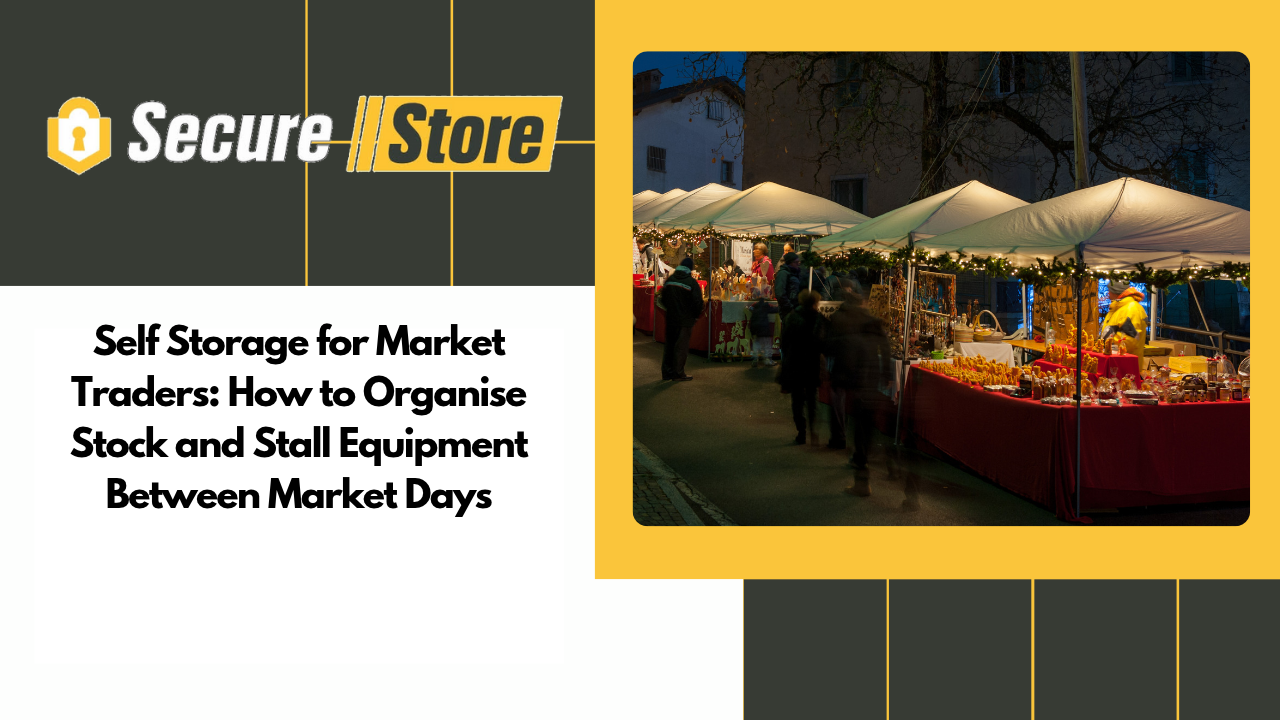
Running a market stall can be a rewarding way to start or grow a business. Whether you sell clothing, handmade gifts, home accessories, books or other non-perishable products, markets offer an opportunity to meet customers face-to-face without committing to a permanent shop.
However, market trading comes with one challenge that many new traders underestimate: where do you keep everything when the market closes?
From folding tables and display stands to boxes of stock, signage, packaging and promotional materials, even a relatively small stall can require a surprising amount of equipment.
If you’re trading several days a week, repeatedly loading and unloading your vehicle can quickly become frustrating.
And if you’re running your business from home, your garage, spare bedroom or hallway may gradually turn into a makeshift stockroom.
At SecureStore Self Storage, we provide flexible storage solutions across Bury, Manchester, Failsworth, Salford and Walkden, helping local businesses find extra space for suitable stock and equipment.
In this guide, we’ll explore how market traders can organise their belongings, protect their stock and make trading days more manageable.
Why Market Traders Need Extra Storage Space
Unlike traditional retailers, market traders often operate without a permanent business premises.
You might sell at a weekly market, attend occasional weekend events or travel between several locations.
That means everything required for your stall needs to be transported, set up, dismantled and stored.
Common items include:
- Folding tables and display counters
- Portable shelving
- Clothing rails
- Display stands
- Signage and banners
- Stock boxes
- Packaging materials
- Non-perishable merchandise
- Tablecloths and display fabrics
- Storage crates
- Suitable spare equipment
Finding somewhere to keep these items between trading days can become increasingly difficult as your business grows.
1. Separate Your Trading Equipment From Your Stock
One of the simplest ways to improve organisation is to keep stall equipment separate from products you’re selling.
Your trading equipment might include tables, rails, display stands and signage.
Your stock could include clothing, accessories, gifts or other merchandise.
By keeping these categories separate, you can find what you need more quickly.
It also helps prevent heavy equipment from damaging products.
For example, you wouldn’t want a metal display stand resting against fragile boxed merchandise.
2. Create a Market Stall Equipment Checklist
A checklist can help prevent forgotten items.
There’s nothing more frustrating than arriving at a market and discovering you’ve left your price labels, table covering or display equipment behind.
Your checklist could include:
| Equipment | Checked |
|---|---|
| Folding tables | Yes / No |
| Display stands | Yes / No |
| Stock boxes | Yes / No |
| Price labels | Yes / No |
| Business signage | Yes / No |
| Packaging supplies | Yes / No |
| Payment equipment | Yes / No |
| Table coverings | Yes / No |
Keep the checklist on your phone or print a copy for your vehicle.
Review it before every trading day.
3. Organise Stock by Product Category
If you sell several types of products, avoid mixing everything together.
For example, a clothing trader could separate:
- Men’s clothing
- Women’s clothing
- Children’s clothing
- Accessories
- Seasonal collections
- Clearance items
A homeware trader might organise products by room, material or price range.
Clearly labelled containers make it easier to identify stock without opening every box.
4. Use Stackable Storage Containers
Suitable stackable containers can help market traders make better use of available space.
Choose boxes that are strong enough for their contents and easy to lift.
Avoid overfilling them.
For fragile items, use appropriate internal protection.
Transparent containers can be useful because you can see what’s inside, although clear labels are still recommended.
5. Keep Heavy Items at the Bottom
When organising your storage space, place heavier equipment at a suitable low level.
Lighter items can be positioned above them where safe.
Avoid creating unstable stacks.
Folding tables, metal stands and other bulky equipment should be secured appropriately.
The aim is to create a storage arrangement that’s practical and safe to access.
6. Protect Your Display Equipment
Your stall presentation can influence how customers perceive your business.
Damaged or dirty displays may make products less appealing.
Before storing equipment:
- Clean it appropriately.
- Allow it to dry.
- Inspect for damage.
- Fold or dismantle it according to instructions.
- Protect vulnerable edges.
- Store it securely.
Well-maintained display equipment can be reused across many trading days.
7. Store Clothing Rails Carefully
Clothing rails are common at fashion markets and vintage clothing stalls.
Some are designed to fold or dismantle.
Follow the manufacturer’s instructions when preparing them for storage.
Keep fittings and components together.
Avoid placing heavy objects against rails that could bend or become damaged.
8. Keep Packaging Materials Organised
Market traders often need a steady supply of packaging.
This might include:
- Paper bags
- Cardboard boxes
- Tissue paper
- Labels
- Wrapping materials
- Suitable protective packaging
Keep packaging clean, dry and separate from dirty stall equipment.
An organised supply makes it easier to prepare for the next market.
9. Manage Stock Between Market Days
If you trade at different markets throughout the week, stock levels can change quickly.
For example, you might attend a market on Wednesday, another on Saturday and a Sunday event.
Without an organised system, it’s easy to lose track of what has sold.
A simple stock spreadsheet can help.
Record:
- Product description
- Quantity available
- Purchase cost
- Selling price
- Quantity sold
- Remaining stock
This can help you make better purchasing decisions.
10. Use Stock Rotation
Some products may sell more quickly than others.
Regularly review your inventory.
Move older suitable stock forward when appropriate and identify products that aren’t selling.
This can help reduce unnecessary purchases and prevent stock from accumulating indefinitely.
11. Plan for Seasonal Markets
Many traders experience changes in demand throughout the year.
For example:
- Spring craft fairs
- Summer outdoor markets
- Autumn community events
- Christmas markets
- Local festivals
Different events may require different displays and merchandise.
Keeping seasonal stock clearly labelled can make preparation easier.
However, don’t assume ordinary self storage is suitable for perishable goods or temperature-sensitive products.
Check SecureStore’s permitted-items policy before storing any merchandise.
12. Christmas Market Traders
Christmas markets can be particularly busy for businesses selling gifts, decorations and handmade products.
You may need additional:
- Display stands
- Gift packaging
- Promotional banners
- Seasonal signage
- Stock boxes
Planning storage in advance can help prevent equipment from taking over your home during the festive trading period.
13. Organise Stock for Different Markets
Not every market attracts the same customers.
You might sell different products at a town-centre market compared with a specialist craft fair.
Consider preparing separate labelled stock collections.
For example:
SATURDAY MARKET STOCK
CRAFT FAIR DISPLAY
SEASONAL PRODUCTS
SPARE STALL EQUIPMENT
This can make loading and preparation more efficient.
14. Reduce Unnecessary Loading and Unloading
Repeatedly moving equipment between your vehicle and home can be time-consuming.
It may also increase the risk of damage.
A suitable storage arrangement can provide a central place for belongings that aren’t needed at home.
However, access arrangements vary by facility.
Check SecureStore’s opening hours and access rules before planning your trading schedule around a storage unit.
15. Keep Your Vehicle Organised
Your vehicle is an important part of your market business.
If it’s overloaded or poorly organised, loading and unloading can become difficult.
Before travelling:
- Check the vehicle’s load capacity.
- Secure equipment properly.
- Distribute weight safely.
- Keep essential items accessible.
- Avoid obstructing visibility.
- Follow applicable road safety requirements.
Don’t leave unsecured heavy equipment in a vehicle.
16. Protect Fragile Merchandise
If you sell ceramics, glassware or decorative items, suitable packaging is essential.
Use protective materials appropriate to the product.
Avoid placing fragile merchandise beneath heavy equipment.
Clearly label boxes that require careful handling.
17. Storing Handmade Products
Many market traders sell handmade goods.
These might include:
- Jewellery
- Decorative crafts
- Printed products
- Wooden ornaments
- Textile accessories
- Home decorations
Storage requirements depend on the materials involved.
Some handmade products may be sensitive to moisture, heat or other environmental conditions.
Confirm suitability before placing them in storage.
18. What About Food Market Traders?
Food businesses have additional storage and hygiene requirements.
Ordinary self storage is generally not suitable for perishable food, and food products may be prohibited.
If you sell food, ensure you have appropriate food storage arrangements that comply with relevant requirements.
For guidance, visit the Food Standards Agency.
Speak to SecureStore about whether any non-food stall equipment can be accommodated.
19. Don’t Store Hazardous Products
Some market traders sell products containing chemicals, aerosols or other potentially hazardous substances.
These may be restricted or prohibited in ordinary self storage.
Do not assume an item is permitted simply because it is packaged for retail sale.
Always check the storage provider’s rules.
20. Keep Promotional Materials Together
Business signage and promotional displays are worth looking after.
You may have:
- Pull-up banners
- Branded tablecloths
- Posters
- Price boards
- Leaflet holders
- Display signs
Store them in appropriate protective packaging.
Keep them separate from items that could cause damage.
21. Prepare for Bad Weather
Outdoor market traders need to plan for changing weather conditions.
Wet stall equipment should be cleaned and thoroughly dried before storage.
Do not pack damp fabrics into sealed containers for extended periods.
Check that equipment is safe and in good condition before its next use.
22. Inspect Your Equipment Regularly
Before each market, inspect tables, stands and other equipment.
Look for:
- Loose fittings
- Damaged hinges
- Bent supports
- Worn fasteners
- Damaged fabric
- Missing components
Repair or replace unsafe equipment.
23. Keep an Inventory of Business Assets
Beyond tracking products for sale, keep a separate record of business equipment.
This could include:
| Asset | Quantity | Condition |
|---|---|---|
| Folding tables | 3 | Good |
| Clothing rails | 2 | Good |
| Display stands | 4 | Good |
| Promotional banners | 2 | Good |
| Storage crates | 12 | Good |
Record approximate replacement costs where useful.
This can help with budgeting and insurance discussions.
24. Plan Your Market Day in Advance
An organised routine can make trading days less stressful.
The day before a market:
- Confirm your booking.
- Check the weather.
- Review your stock.
- Prepare suitable packaging.
- Check display equipment.
- Charge payment devices safely at an appropriate location.
- Plan your route.
- Prepare your loading checklist.
Good preparation can help you spend more time serving customers.
25. Avoid Buying Too Much Stock
Buying in bulk can sometimes reduce costs.
However, excess stock ties up money and occupies space.
Before purchasing more products, review your sales history.
Consider how quickly items sell and whether the additional quantity is worthwhile.
Storage should support an efficient business rather than encourage unnecessary accumulation.
26. Calculate Your Business Costs
Market traders need to consider more than the price of their merchandise.
Operating costs may include:
- Market pitch fees
- Transport
- Stock purchases
- Packaging
- Payment processing
- Insurance
- Storage
- Equipment maintenance
Keeping accurate records can help you understand your profitability.
For general business guidance, visit GOV.UK.
27. Choosing the Right Storage Unit
The amount of space required depends on the size of your stall and the volume of stock.
A small jewellery stall may need considerably less space than a trader with multiple clothing rails and large display counters.
Before booking:
- List your stock and equipment.
- Measure bulky items.
- Check which products are permitted.
- Consider how frequently you’ll need access.
- Allow for safe movement.
- Confirm the storage conditions.
- Compare available unit sizes.
SecureStore offers a range of storage options, including smaller internal units and larger spaces.
28. Keep Your Storage Space Organised
A storage unit is most useful when you can find what you need.
Consider creating clearly labelled areas for:
CURRENT STOCK
SEASONAL STOCK
STALL EQUIPMENT
PACKAGING
PROMOTIONAL MATERIALS
Keep access routes clear and avoid unstable stacks.
29. Consider Insurance
Stock and market equipment can represent a significant financial investment.
SecureStore offers storage insurance options.
Speak to the team about the value and nature of the belongings you intend to store.
Check whether your existing business insurance covers stock stored away from your home or usual trading location.
30. Removal + Storage for Bulky Equipment
Some traders use large display counters, shelving or other awkward equipment.
SecureStore provides Removal + Storage for suitable belongings.
Contact the team about dimensions, weight and handling requirements.
31. When Might You Need Commercial Premises Instead?
Self storage can help with suitable stock and equipment, but it isn’t automatically a place to operate a retail business.
Activities such as customer visits, trading from the unit, food preparation or running a workshop may be restricted.
If your business needs a permanent showroom, preparation area or customer-facing premises, consider suitable commercial accommodation.
32. Review Your Storage Needs as Your Business Grows
Your storage requirements may change over time.
You might begin with one small stall and eventually trade at several markets.
Review how much equipment and stock you actually use.
A flexible approach can help you avoid committing to more space than necessary.
Ask About SecureStore’s Introductory Offers
SecureStore previously ran a limited two-week flash promotion offering eligible customers their first month of storage for £1.
If you’re looking for additional business storage, ask whether this promotion or another introductory offer is currently available.
All offers are subject to eligibility, availability and applicable terms.
How to Book Your Unit With SecureStore
If you’re a market trader looking for additional space, getting started is straightforward.
- Review your stock and equipment.
- Separate everyday essentials from occasional-use items.
- Identify any prohibited or specialist-storage products.
- Clean and dry suitable equipment.
- Measure bulky items.
- Organise stock into labelled containers.
- Create an inventory.
- Consider your access requirements.
- Contact SecureStore to discuss available units.
- Ask about Removal + Storage and current introductory offers.
SecureStore Self Storage
Call: 0161 470 0288
Email: info@securestoreselfstorage.co.uk
Visit: 574 Manchester Road, Bury, BL9 9SW
Locations: Bury | Manchester | Failsworth | Salford | Walkden
Our team can discuss available units, permitted belongings and suitable storage arrangements.
Give Your Market Business Room to Grow
Running a successful market stall requires more than finding the right products.
You also need to organise stock, maintain equipment, prepare for trading days and manage your time efficiently.
When your garage becomes a stockroom and your vehicle is permanently full of display equipment, it may be time to review your storage arrangements.
By keeping an accurate inventory, separating stock from equipment and using suitable storage where appropriate, you can create a more organised business.
SecureStore provides flexible self storage and Removal + Storage across Bury, Manchester, Failsworth, Salford and Walkden.
Whether you trade at a weekly market, attend seasonal craft fairs or operate several stalls, contact our team to discuss your storage requirements.
Call 0161 470 0288 or email info@securestoreselfstorage.co.uk.
Frequently Asked Questions
Can market traders use self storage?
Yes. Suitable non-perishable stock, stall equipment and other permitted business belongings may be stored, subject to SecureStore’s terms and availability.
Can I keep clothing stock in a storage unit?
Suitable clean, dry clothing may be permitted. Check the storage environment and packaging requirements, particularly for delicate fabrics.
Can I collect stock before an early morning market?
Access arrangements depend on the facility and your agreement. Contact SecureStore to confirm available access hours before booking.
Can I sell products directly from my storage unit?
Ordinary self storage isn’t automatically suitable for retail trading or customer visits. Confirm SecureStore’s permitted uses before making arrangements.
Does SecureStore offer storage for large market stall equipment?
SecureStore offers different storage sizes and Removal + Storage for suitable belongings. Contact the team with details of your equipment to discuss availability.