
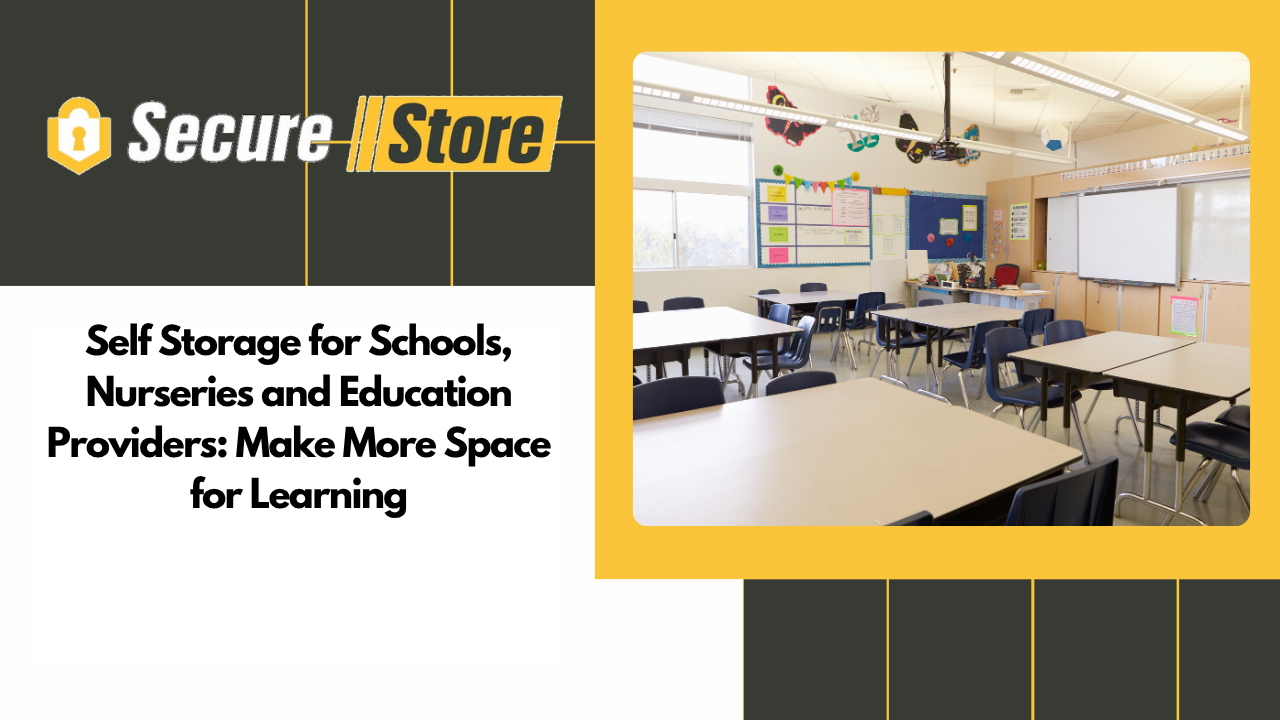
Schools and nurseries are supposed to use their space for learning.
Yet open almost any storage cupboard and you may find something very different.
Christmas decorations.
Sports equipment.
Tables.
Chairs.
Display boards.
Costumes from last year’s production.
Boxes of teaching resources.
Summer-fair equipment.
Furniture that might be needed again.
And resources for a topic nobody is teaching until next term.
Individually, these belongings make sense.
Together, they can consume valuable space.
For schools, nurseries, tutoring businesses, training providers and other education organisations across Greater Manchester, flexible self storage can provide additional space for suitable equipment and resources that don’t need to remain on site every day.
SecureStore provides flexible storage across Bury, Manchester, Failsworth, Salford and the wider Greater Manchester area.
Educational Settings Have Highly Seasonal Storage Needs
Education works in cycles.
A school doesn’t need Christmas decorations in May.
Sports-day equipment may not need prime cupboard space in December.
Summer-fair materials might only be used once a year.
The same applies to:
- Seasonal displays
- Costumes
- Event equipment
- Outdoor resources
- Spare furniture
- Examination equipment
- Exhibition materials
This makes education particularly well suited to a rotational approach to suitable storage.
Start With the Storage Cupboards
Before considering additional space, understand what you already have.
Review:
- Stockrooms
- Cupboards
- Staff areas
- Store rooms
- Offices
- Appropriate external stores
You may discover that a substantial amount of space is occupied by belongings that are rarely used.
Create three categories:
USED REGULARLY
SEASONAL / OCCASIONAL
NO LONGER REQUIRED
Regularly used resources should remain convenient.
Suitable seasonal belongings may be candidates for external storage.
Items genuinely no longer required should be dealt with appropriately rather than moved from one storage location to another.
Don’t Store Things Simply Because Nobody Wants to Make a Decision
This is one of the easiest ways for organisational storage to become unmanageable.
Someone asks:
Do we still need this?
Nobody knows.
So it goes back into the cupboard.
Repeat that for several years and the cupboard eventually contains a history of the organisation rather than useful resources.
Give uncertain items a review date.
If nobody has needed them by then, make a proper decision.
Create a Seasonal Rotation
A school or nursery could organise suitable stored resources around the academic calendar.
Autumn
You might bring back:
- Autumn displays
- Appropriate indoor resources
- Christmas production materials
- Seasonal decorations
Spring
You might rotate towards:
- Spring displays
- Easter resources
- Outdoor-learning materials
- Event equipment
Summer
You might require:
- Sports-day resources
- Summer-fair equipment
- Outdoor-event materials
- End-of-year display equipment
The exact system will depend on your setting.
The principle is what matters:
Only keep what you currently need in your most valuable on-site storage space.
Christmas Decorations Can Take Up Enormous Space
Schools and nurseries often accumulate Christmas materials over many years.
You might have:
- Artificial trees
- Decorations
- Stage props
- Nativity costumes
- Display materials
- Lights
- Boxes of craft resources
These can be essential in November and December.
In February, they’re occupying space that could be used for something else.
Suitable seasonal storage allows them to be organised together until the next festive period.
Create a Christmas Inventory
Don’t simply label twelve boxes:
CHRISTMAS
Be more specific.
For example:
CHRISTMAS – MAIN HALL DECORATIONS
CHRISTMAS – NATIVITY COSTUMES
CHRISTMAS – STAGE PROPS
CHRISTMAS – RECEPTION DISPLAY
Next December, staff will know exactly which box they need.
School Productions Create Their Own Storage Problem
A school play or production can generate a surprising amount of equipment.
There may be:
- Costumes
- Props
- Suitable scenery components
- Display boards
- Reusable decorations
Some of these resources may be valuable enough to keep for future productions.
But don’t keep absolutely everything.
After the production, review each item.
Ask:
Will we realistically use this again?
If not, consider whether it can be reused elsewhere, donated or responsibly disposed of.
Sports Equipment Needs Organisation Too
Sports resources can consume large amounts of space.
Suitable equipment might include:
- Training equipment
- Cones
- Bibs
- Mats
- Appropriate event equipment
- Sports-day resources
Frequently used PE equipment should normally remain easily accessible.
But specialist or seasonal resources may not need to occupy the same prime storage areas throughout the year.
Follow manufacturer recommendations for particular equipment.
Sports Day Is a Perfect Example
Sports day may require equipment that isn’t regularly used during normal lessons.
Rather than searching across multiple cupboards the week before the event, create a dedicated:
SPORTS DAY
inventory.
After the event:
- Check everything has been returned.
- Inspect equipment.
- Clean suitable items.
- Replace missing or damaged resources.
- Repack everything together.
Next year, preparation becomes much easier.
Summer Fairs and Fundraising Events
Schools and nurseries frequently run:
- Summer fairs
- Christmas fairs
- Open days
- Fundraising events
- Parent evenings
- Community events
Over time, event equipment can accumulate.
You may have suitable:
- Gazebos
- Tables
- Signs
- Display equipment
- Banners
- Decorations
- Reusable event materials
Keeping a dedicated event inventory prevents these belongings from becoming mixed with everyday educational resources.
Create an Event Kit
Instead of reinventing every event, create a standard reusable kit.
For example:
SCHOOL FAIR KIT
Then maintain an inventory.
After each event, check what needs replacing before putting the kit away.
This can reduce last-minute purchasing and preparation.
Spare Furniture Can Become a Major Problem
Education settings often have furniture that is temporarily surplus.
Perhaps:
- A classroom has been reorganised.
- Pupil numbers have changed.
- New furniture has arrived.
- A room is being refurbished.
- Tables and chairs may be needed next year.
Immediately disposing of useful furniture may not make sense.
But leaving it stacked in a classroom isn’t ideal either.
Suitable temporary storage can provide another option while the organisation decides what will be required.
Don’t Store Low-Value Furniture Forever
There is an important balance.
Storage has a cost.
If furniture is inexpensive, badly worn and unlikely to be used again, storing it indefinitely may not make financial sense.
Ask:
What would it cost to replace this?
When are we realistically going to use it?
Is it still in suitable condition?
Storage should support good resource management, not postpone disposal decisions.
Classroom Refurbishments
Refurbishing a classroom can require furniture and resources to be moved temporarily.
Rather than squeezing everything into neighbouring rooms, suitable items can potentially be moved elsewhere during the works.
This may make it easier for contractors to access the space and help prevent unaffected classrooms from becoming temporary storerooms.
Nursery Resources Can Multiply Quickly
Nurseries and early-years settings often have substantial volumes of:
- Toys
- Role-play equipment
- Furniture
- Seasonal resources
- Outdoor-learning equipment
- Display materials
- Craft resources
Rotating resources can already be part of good classroom organisation.
External storage can extend that principle where suitable.
Instead of every resource being available simultaneously, selected appropriate items can be rotated according to current activities and themes.
Keep Resources Organised by Age or Classroom
If several classes use stored materials, label them properly.
For example:
RECEPTION – AUTUMN
YEAR 2 – SCIENCE RESOURCES
NURSERY – CHRISTMAS
WHOLE SCHOOL – EVENT EQUIPMENT
Clear ownership makes retrieval easier.
Training Providers Can Benefit Too
Not every education business operates from a traditional school.
Training providers may deliver:
- Professional courses
- First-aid training
- Workplace training
- Adult education
- Practical workshops
They may operate from hired venues rather than permanent premises.
This can create a need for somewhere to keep suitable:
- Training equipment
- Display stands
- Course materials
- Folding equipment
- Demonstration resources
- Marketing materials
A central storage base can be useful between courses.
Tutoring Businesses Can Outgrow the Spare Room
A tutoring business may begin with little more than a laptop and some books.
As it expands, resources can accumulate.
You may have:
- Books
- Worksheets
- Teaching aids
- Display materials
- Appropriate furniture
- Marketing materials
If tutors work from several locations, a central location for suitable surplus resources can make organisation easier.
Keep an Inventory
The more people who use organisational equipment, the more important inventory management becomes.
Create a simple record showing:
- Item
- Category
- Quantity
- Location
- Condition
- Review date
It doesn’t need to be complicated.
A spreadsheet can be sufficient.
Number Your Boxes
Don’t rely entirely on written descriptions.
Use a numbering system.
For example:
EDU-001
EDU-002
EDU-003
Your inventory can then say:
EDU-002 – Christmas production costumes
This makes updating records easier when boxes are moved.
Photograph Box Contents
Before closing suitable boxes, photograph their contents.
This provides a quick visual reference.
Staff can potentially check the inventory before travelling to retrieve something.
It also reduces unnecessary searching through multiple boxes.
Nominate Someone to Manage Stored Resources
A shared storage system with no clear responsibility can quickly become disorganised.
Where appropriate, nominate a member of staff or responsible person to oversee:
- Inventory updates
- New items entering storage
- Items being removed
- Periodic reviews
This doesn’t need to become a major role.
Someone simply needs to maintain the system.
Use a Check-Out System
If resources move in and out regularly, record it.
For example:
ITEM: Event banner
REMOVED: 12 June
FOR: Summer fair
RETURNED: 17 June
Without a simple system, staff can assume something is in storage when it is actually sitting in another classroom.
Don’t Store Sensitive Records Casually
Schools and education providers handle substantial amounts of personal and sensitive information.
Do not treat general self storage as a substitute for proper information governance.
Personal records, safeguarding information, pupil information and other sensitive material require appropriate handling, retention, security and disposal procedures.
Schools and organisations should follow their own policies and current legal requirements.
The Information Commissioner’s Office provides official UK guidance on data protection.
Understand Record-Retention Requirements
Don’t automatically store paperwork forever.
Organisations should have appropriate retention schedules and disposal procedures.
Where records must be retained, ensure the chosen arrangements are appropriate for the information involved.
Where records can lawfully be destroyed, use an appropriate secure process.
Health and Safety Still Matters
Storage areas need to remain safely organised.
Avoid:
- Unstable stacks
- Blocked access
- Excessively heavy boxes
- Equipment positioned where it could fall
The Health and Safety Executive provides official UK workplace health and safety guidance.
Your organisation should assess risks relevant to its own staff, equipment and activities.
Be Careful With Art and Science Materials
Education settings may use paints, aerosols, chemicals, laboratory materials and other products that are unsuitable or prohibited for self storage.
Never assume something can be stored simply because it is used in a classroom.
Hazardous, flammable, corrosive, toxic and other prohibited substances cannot be placed into storage.
Ask SecureStore before bringing in anything you’re uncertain about.
Batteries and Electrical Equipment Need Consideration
Some education resources contain batteries or electrical components.
Always follow manufacturer guidance and SecureStore’s rules regarding the particular equipment.
If you’re uncertain about an item, ask before storing it.
Create a Termly Review
At the end of each term, review what is being kept.
Ask:
Was this used?
Will it be used next term?
Is it still part of the curriculum or programme?
Is it still in good condition?
Is the quantity appropriate?
A regular review prevents storage from becoming an archive of forgotten resources.
The End of the Academic Year Is a Major Opportunity
The summer break can be an ideal time for a larger storage review.
Classrooms may be reorganised.
Furniture may change.
Resources may move between year groups.
New equipment may arrive.
Instead of moving clutter from one classroom to another, use the opportunity to properly review suitable resources.
Prepare for September Before the Summer Break
Don’t wait until staff return to begin searching for autumn resources.
Before the end of term:
- Identify what will be needed first in September.
- Make it easily accessible.
- Label it clearly.
- Update the inventory.
This can make the start of the new academic year much smoother.
Storage Can Help During Building Works
Schools and nurseries may periodically undertake:
- Classroom refurbishments
- Flooring work
- Decorating
- Electrical work
- Building improvements
Suitable temporary storage can help clear affected spaces while work takes place.
SecureStore also provides Removal + Storage solutions, so speak to our team about larger quantities of suitable furniture or equipment.
Don’t Buy Resources You Already Own
Poor storage organisation can lead to unnecessary spending.
A teacher or administrator can’t find something.
So another one gets ordered.
Months later, the original appears.
Before buying replacement seasonal or event equipment, check your inventory.
A good storage system can support better purchasing decisions.
Storage Can Support Growing Education Businesses
Private education and training businesses can expand quickly.
A provider might begin with one tutor or trainer and later operate:
- Multiple classes
- Several instructors
- Different venues
- Larger courses
The volume of suitable equipment and teaching resources grows with it.
Flexible storage can provide additional capacity without immediately requiring a larger permanent office.
Professional Mailbox Service
SecureStore also provides a professional mailbox service from £5 per week.
This may be useful for suitable independent tutoring or training businesses that operate from home or hired venues and want a dedicated correspondence address for everyday business mail.
A correspondence mailbox and statutory registered office aren’t automatically the same thing. Limited companies should check current requirements through Companies House.
Storage Insurance
Education resources and equipment can represent a significant combined value.
Suitable belongings placed into storage require appropriate insurance.
Create an inventory and consider the replacement value of appropriate:
- Furniture
- Equipment
- Teaching resources
- Event materials
SecureStore can provide storage insurance at a very competitive price.
Speak to our team about the belongings being stored and make sure the declared value is appropriate.
Frequently Asked Questions
Can schools use self storage?
Self storage can provide additional space for many types of suitable furniture, seasonal resources, event equipment and other permitted belongings. The organisation should ensure its own policies and requirements are followed.
Can nurseries store toys and educational resources?
Many suitable clean and dry resources may be appropriate for storage. Check manufacturer guidance and ask SecureStore if you’re uncertain about a particular item.
Can confidential pupil records be kept in self storage?
Sensitive information requires appropriate data-protection, retention and security arrangements. Schools should follow their own policies and current legal requirements rather than assuming general storage is appropriate.
Can school furniture be stored during refurbishment?
Suitable furniture may be stored temporarily during refurbishment works. Speak to SecureStore about the volume and type of items involved.
Can SecureStore help move larger quantities of equipment?
SecureStore provides Removal + Storage solutions. Speak to our team about suitable furniture, resources and equipment that need moving.
How to Organise Storage for a School, Nursery or Training Provider
- Audit existing storage areas.
- Separate everyday and seasonal resources.
- Remove genuinely obsolete items.
- Create categories around the academic year.
- Label every box clearly.
- Number boxes and maintain an inventory.
- Photograph appropriate contents.
- Keep sensitive records under appropriate information-governance arrangements.
- Confirm every item is permitted for storage.
- Keep upcoming seasonal resources accessible.
- Nominate responsibility for the storage system.
- Review stored resources each term.
- Arrange suitable insurance.
- Ask SecureStore about Removal + Storage for larger moves.
Use Educational Space for Education
Every square foot in a school, nursery or training environment has potential value.
A cupboard filled with Christmas decorations for eleven months of the year isn’t necessarily being used efficiently.
Neither is a spare classroom filled with old furniture.
Or an office surrounded by equipment for events that happen twice a year.
The answer isn’t necessarily to throw everything away.
It’s to distinguish between what needs to be on site today and what simply needs to be available when required.
Organise suitable resources.
Rotate seasonal equipment.
Keep an accurate inventory.
Remove things you genuinely no longer need.
And give staff easier access to the resources that matter now.
SecureStore provides flexible storage for businesses and organisations across Bury, Manchester, Failsworth, Salford and the wider Greater Manchester area.
Telephone: 0161 470 0288
Email: info@securestoreselfstorage.co.uk
Visit: 574 Manchester Road, Bury, BL9 9SW
SecureStore provides flexible personal and business self storage, Removal + Storage and professional mailbox services across Greater Manchester.